What is RAG, Really? (Explained for Developers Who Use AI Daily)
Retrieval-Augmented Generation, explained without the jargon — for devs who use Claude or ChatGPT but don't know what's happening underneath.
Here's something you've probably run into: you ask Claude or ChatGPT a question like "What's in our team's latest project doc?" or "What happened in the news this morning?" — and it either confidently makes something up, or tells you it doesn't have access to that information.
That's not the model being "dumb." It's the model doing exactly what it was trained to do: predict the next word based on patterns it learned during training, which ended at some point in the past and never included your private documents in the first place.
So how do tools like Notion AI, customer-support chatbots, or "chat with your PDF" apps get around this? They don't retrain the model every time new data shows up — that would be absurdly slow and expensive. Instead, they use something called Retrieval-Augmented Generation, or RAG.
What RAG Actually Is
Here's the simplest way to think about it: RAG is the difference between a closed-book exam and an open-book exam.
A regular LLM, on its own, is taking a closed-book exam. It answers purely from what it memorized during training — no peeking, no references, just recall. That's fine for general knowledge, but it falls apart the moment you ask about something outside that training data: your company's internal docs, this morning's news, or a PDF you just uploaded.
RAG turns it into an open-book exam. Before the model answers, it's handed a small, relevant set of "pages" to reference — pulled from wherever your actual data lives. The model still does the reasoning and writing, but now it's reasoning over real, current information instead of guessing from memory.
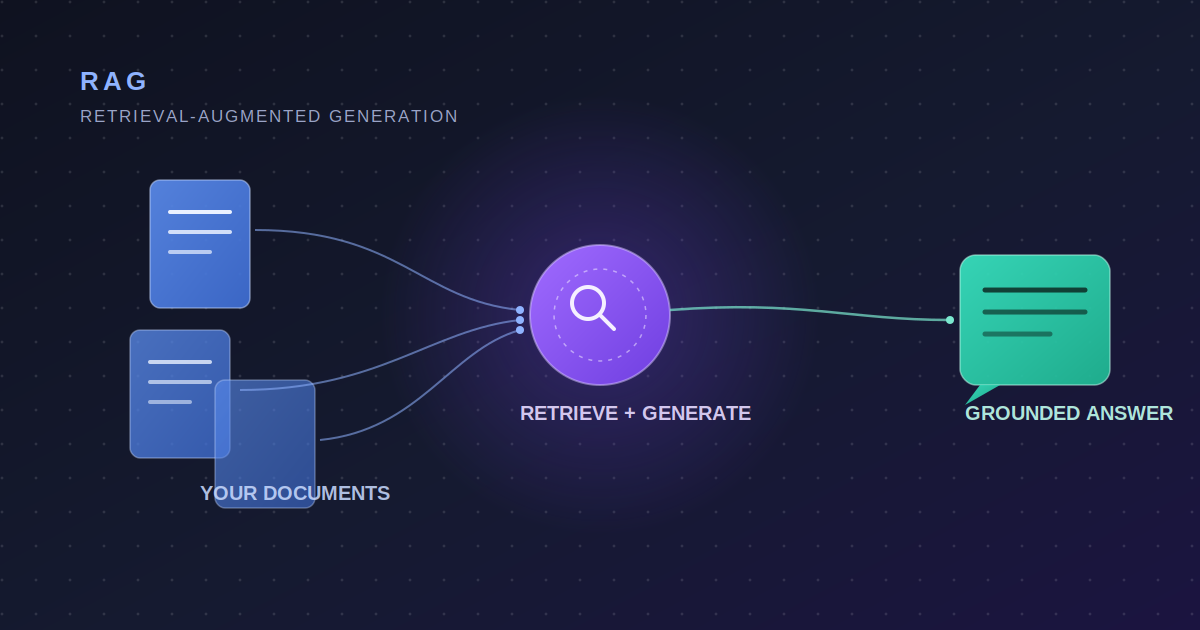
That's really all RAG is: retrieval (go find the relevant information) plus generation (use it to write a grounded answer). Two separate steps, working together, instead of relying on the model's memory alone.
It sounds almost too simple to have a name — and conceptually, it is. The complexity shows up in how you retrieve the right information efficiently, which is exactly what we'll get into next.
The Two Core Pieces: Retrieval and Generation
Now let's open up the "open book" analogy a bit. RAG has exactly two moving parts, and understanding them is really the whole game.
1. Retrieval — finding the right pages
Before your documents can be searched, they go through a one-time setup:
Your documents (PDFs, docs, articles, whatever) get broken into small chunks — usually a few paragraphs each.
Each chunk gets converted into a list of numbers called an embedding — a mathematical representation of what that chunk means, not just the words in it.
These embeddings get stored in a vector database, built specifically for finding "similar" pieces of text fast.
Then, at question time:
Your question also gets converted into an embedding, using the same process.
The system compares your question's embedding against every chunk's embedding, and pulls out the ones that are closest in meaning.
This is why RAG can find a relevant answer even if your question doesn't share a single exact word with the source document — it's matching on meaning, not keywords.
2. Generation — writing the answer
Once the most relevant chunks are found, they get handed to the LLM along with your original question, roughly like this:
"Here's some context: [retrieved chunks]. Using only this context, answer the question: [your question]."
The model then does what it's always done best — read text and generate a coherent response — except now it's reasoning over real, retrieved information instead of whatever it happens to remember from training.
That's the full loop: chunk → embed → store → retrieve → generate. Everything else you'll hear about RAG (chunking strategies, re-ranking, hybrid search) is just refinement on top of these two steps.
A Real-World Example: The HR Policy Chatbot
Let's make this concrete with a scenario you've probably seen at some company (maybe even yours).
The problem: A company has a 50-page HR policy PDF — leave policy, reimbursement rules, work-from-home guidelines, the works. Employees keep asking HR the same questions over and over. Someone decides to build a chatbot so employees can just ask it directly.
Without RAG: You could paste the whole 50-page PDF into every conversation, but that's expensive, slow, and most models still lose track of details buried in the middle of a huge document. Or you could fine-tune a model on the policy text — but now every time HR updates a single paragraph, you'd need to retrain the model. Neither option scales.
With RAG, here's the actual flow:
The 50-page PDF gets split into chunks — maybe one chunk per policy section (leave policy, WFH policy, reimbursements, etc.).
Each chunk gets embedded and stored in a vector database.
An employee asks: "How many casual leaves do I get per year?"
That question gets embedded too, and compared against all the stored chunks.
The 2-3 chunks most related to "casual leave" get pulled out — probably just the leave policy section, ignoring the other 47 pages.
Those chunks, plus the question, get sent to the LLM: "Using this context, answer: how many casual leaves do I get per year?"
The model answers using the actual policy text — not a guess, not a hallucination.
Why this matters: If HR updates the leave policy tomorrow, you don't retrain anything. You just re-embed that one updated section and drop it back into the vector database. The chatbot's "knowledge" stays current automatically, at a fraction of the cost of retraining a model.
This same pattern — chunk your data, embed it, retrieve relevant pieces, generate an answer — is exactly what powers "chat with your PDF" tools, customer support bots, and internal knowledge assistants you've probably already used.
Why Not Just Fine-Tune, or Use a Bigger Context Window?
If RAG sounds like extra machinery, it's fair to ask: why not just skip it?
Option 1: Fine-tune the model on your data
Fine-tuning means retraining the model on your specific documents so the knowledge gets baked into its weights. The problem is cost and speed. Every time your data changes — a new policy, an updated price list, a fixed bug in the docs — you'd need to retrain. That's slow, expensive, and impractical for anything that updates more than rarely. Fine-tuning is better suited for teaching a model a style or skill, not for keeping it current on facts.
Option 2: Just paste everything into a huge context window
Modern models support surprisingly large context windows now, so why not just paste your entire document set into every conversation? A few reasons this breaks down in practice:
Cost — you're paying for every token, every single request, even if only one paragraph out of 50 pages was actually relevant.
Latency — bigger inputs mean slower responses.
Needle-in-a-haystack problem — models are demonstrably worse at picking out one specific fact buried in the middle of a massive input, compared to being handed just the relevant piece directly.
Where RAG wins
RAG sidesteps both problems: it stays cheap and fast because it only retrieves the small slice of data that's actually relevant to the question, and it stays current because updating your data is as simple as re-embedding the changed piece — no retraining required.
That said, RAG isn't automatically "better" in every case — it's a trade-off. For small, static datasets that fit comfortably in a context window, skipping RAG entirely can be simpler. The real skill is knowing when the retrieval step earns its complexity.
A Pitfall Worth Knowing: Bad Retrieval Breaks Everything
Here's something that surprises people when they first build a RAG system: the LLM is rarely the weak link. Retrieval is.
If the wrong chunks get pulled out — or the right chunks but too much surrounding noise — the model will confidently generate an answer based on irrelevant context. It's not hallucinating in the traditional sense; it's doing exactly what it was told, with bad information handed to it.
A few common ways this goes wrong:
Chunks too large — you retrieve a chunk that technically contains the answer, but it's buried in three paragraphs of unrelated policy text, diluting what the model focuses on.
Chunks too small — you split a policy sentence away from its context (e.g., the leave number gets separated from which leave type it refers to), and now the retrieved piece is technically accurate but meaningless on its own.
Similar-but-wrong matches — a question about "sick leave" retrieves a chunk about "leave without pay" because the embeddings judged them close enough in meaning, even though they're different policies entirely.
None of these are bugs in the LLM. They're tuning problems in the retrieval step — chunk size, overlap between chunks, and sometimes needing a second pass (called re-ranking) to double-check that what got retrieved is actually relevant before handing it to the model.
The takeaway: a RAG system is only as good as what it retrieves. Getting the generation step right is the easy part — getting the retrieval step right is where the real engineering happens.
The Takeaway
RAG isn't magic, and it isn't a new kind of AI. It's a fairly simple idea — retrieve the relevant information first, then let the model generate an answer using it — bolted onto a language model that would otherwise be stuck relying on memory alone.
That simple idea is quietly the backbone of most "chat with your data" products you've probably already used: support bots, internal knowledge assistants, "chat with your PDF" tools, and a good chunk of what people now call AI agents.
Understanding this one pattern — chunk, embed, retrieve, generate — gives you a real mental model for how a huge slice of practical AI tooling actually works under the hood, instead of it feeling like a black box.
This is the first post in a short series where I'm breaking down the AI concepts developers keep running into but rarely see explained simply — next up: vector databases and embeddings, going one level deeper into how that "retrieval" step actually finds the right information.
If this was useful, follow along for the rest of the series — and if you've built or used a RAG system yourself, I'd genuinely like to hear what tripped you up. Drop it in the comments.