Prompt Versioning & Regression Testing: Treating Prompts Like Code
Prompt Versioning & Regression Testing
You tweak one line in your system prompt. Just a tone fix — the bot was being too chatty before handing off a refund request. You ship it, the diff is three words long, and you move on with your day.
Two days later a support ticket lands: the bot stopped mentioning the mandatory refund disclaimer. Nobody touched that sentence. But your "small tone fix" also nudged the model's attention away from an instruction four lines down, and on certain inputs it now skips it entirely. You find this out from an angry customer, not from a test, because there was no test. There was no test because nobody thinks of a prompt as something you test. It's just... a string. You edit it in place, ship it, and hope.
This is the gap that prompt versioning and regression testing close. The idea itself isn't exotic — it's the same discipline you already apply to code — but almost nobody applies it to prompts, and that gap is exactly where silent regressions live.
What prompt versioning and regression testing actually is
Strip away the tooling and it's two old ideas, borrowed from software engineering and pointed at a new kind of artifact.
Versioning means a prompt isn't "the prompt" — singular, mutable, living in one variable that gets overwritten every time someone edits it. It's a history. Every saved edit becomes its own immutable snapshot, and a label like production or staging points at exactly one snapshot at a time. Your app doesn't ask for "the latest prompt," it asks for "whatever production currently points to." That's the difference between editing a Word doc and using git: one of them lets you prove what changed and roll it back.
Regression testing means you keep a fixed set of inputs — real or representative examples — paired with checks on what a good output looks like. Every time the prompt changes, you run that same set through the new version and compare. Not "does this look fine to me," but "does this still pass the same checks it passed yesterday." If it doesn't, you've caught a regression before a customer did.
Neither half is new. What's new is that teams are finally admitting prompts deserve the same treatment as the code around them, instead of living as magic strings nobody reviews.
The core technical pieces
Versioning: labels instead of memory
Tools built for this — Langfuse is one — save a new, immutable version every time a prompt is edited, rather than overwriting the old one. Deployment is controlled separately, through labels: you might have a production label and a staging label, each pointing at exactly one version at a time. Promoting a prompt means moving a label, not editing text. Your application code fetches "whatever production points to" via the SDK, so a rollback is relabeling an old version back into place, not trying to remember what the text used to say.
The eval suite: your regression test file
This is the part that actually catches regressions. It's a set of test cases — an input, and some assertion about what the output should contain, avoid, or look like — stored as plain files. Promptfoo, for example, treats prompts and their test cases as YAML files that live in your repo next to the code that calls them. Git becomes the version store and the eval suite travels with the prompt, not off in someone's browser tab.
The CI gate
Once the eval suite exists as files, it can run anywhere a shell command can run — including a pull request. A command like:
npx promptfoo@latest eval --fail-on-error
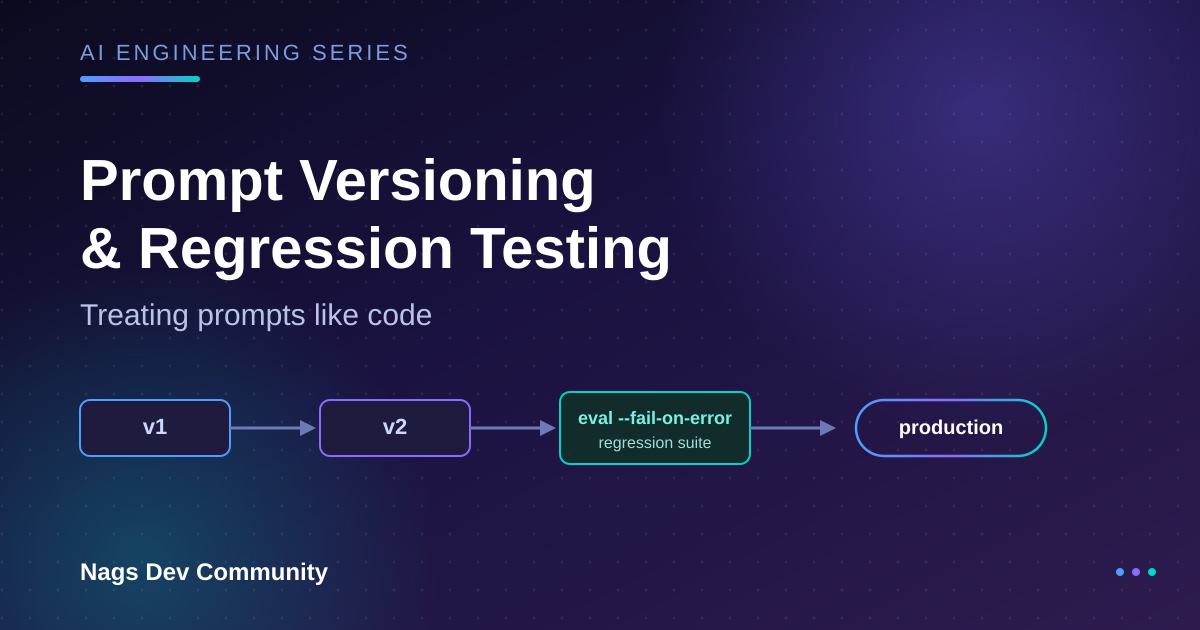
runs the full suite and fails the job if any assertion fails. The regression workflow is simple: capture a baseline by running the suite against the current prompt, make your change, re-run the suite against the new version, and compare. If something that used to pass now fails, the PR fails, the same way a broken unit test blocks a merge.
Connecting the two
The versioning layer and the testing layer aren't separate worlds. Promptfoo can pull a prompt directly out of Langfuse with a reference like langfuse://prompt-name@production, which means the thing you're regression-testing is the exact labeled version that's about to ship — not a copy-pasted approximation of it that's already drifted out of sync.
A real-world example
Picture a small team running an invoice-extraction feature: a prompt pulls vendor name, total amount, and due date out of raw invoice text. It's been stable for months, stored as prompts/v1.txt.
Someone notices the prompt occasionally grabs the wrong date when an invoice lists both an issue date and a due date, so they write a tightened version — clearer instructions about which date to prefer — and save it as prompts/v2.txt. Before anyone merges that change, a GitHub Action kicks off automatically on the pull request. It runs the eval suite — a batch of sample invoices with known-correct answers — against both v1.txt and v2.txt and diffs the results.
The new prompt fixes the due-date confusion, exactly as intended. But the suite also flags a case it wasn't trying to fix: an invoice with multiple line items now has the vendor name extraction fail, something the tightened date wording accidentally threw off. That's a real pattern pulled from public CI setups built around this exact workflow — comparing two prompt versions file-by-file under a fixed test battery, on every pull request, before either one reaches production. Nobody has to notice the regression by eye. The suite notices it before the PR is even approved.
Why not just eyeball it, or just use one big platform?
The obvious lightweight alternative is manual review: someone reads the new output, it looks fine, it ships. That works until it doesn't — a human reviewer checks the cases they think of, not the edge case an eval suite was built to remember on their behalf. Manual review scales with how much you remember to check; automated regression testing scales with how many test cases you're willing to write once.
The other direction is going all-in on a heavyweight, all-in-one observability and evaluation platform — think LangSmith for LangChain-centric teams, or Braintrust when datasets, scorers, and online scoring need to be first-class citizens of your whole development loop. These are genuinely strong choices when evaluation is central to how your team works and you want dashboards, traces, and experiment tracking in one place. The trade-off is weight: you're adopting a platform, not just a CLI step.
A code-first tool like promptfoo sits at the other end — it's just files and a CLI command, which means it slots into a GitHub Action in an afternoon and asks nothing of your stack beyond "can you run npx." The cost is that you get a pass/fail signal and a diff, not a dashboard. Most teams don't need to choose permanently; plenty start with the lightweight CI gate and add a fuller eval platform once prompt quality becomes something several people need to watch, not just one.
A pitfall worth knowing
A regression suite passing is not the same thing as your prompt being good. It means the prompt still does the specific things you thought to test for, on the specific examples you happened to write down when you built the suite.
That eval set is frozen the moment you write it. Real traffic keeps moving — users phrase things your five sample invoices never anticipated, the underlying model gets a silent update from the provider, a new document format shows up. None of that fails your CI gate, because your CI gate only knows about the world as it looked on the day you wrote the test cases. Teams that build a regression suite once and never revisit it get a false sense of safety: green checkmarks on every PR, while real-world quality quietly drifts somewhere the suite never thought to look.
The fix isn't exotic — it's the same thing you'd do for a code test suite that's gone stale: feed real production failures back into the eval set as new cases, periodically, instead of treating the suite as something you wrote once and trust forever.
The takeaway
Prompts fail silently because most teams treat them as strings instead of artifacts — nothing tracks what changed, and nothing checks whether the change broke something that used to work. Versioning gives you a provable history and a safe way to roll back. Regression testing gives you a way to know a change is safe before a customer tells you otherwise. Put a labeled, versioned prompt behind a CI-gated eval suite, and that three-word tone fix either passes cleanly or fails loudly in a pull request — not in a support ticket two days later.
Next up in this series: the flip side of sending careful, tested prompts to a model — what you should never let a prompt or your app send to an LLM API in the first place, and why PII slips through more often than you'd think.
If you want a fast way to actually retain what this series covers, Stropdeck™ — the interview-prep flashcard app built alongside this blog — is now free on Google Play for Android, available in 20+ countries including India, the US, UK, Canada, Australia, Singapore, the Gulf states and more. Every post in this series becomes a 10-card deck you can run through before an interview: Get Stropdeck on Google Play
About the author
- I build scalable web apps, experiment with AI, and turn complex engineering problems into working products.
Comments
Join the discussionNo comments yet. Be the first to comment.